Docks, boat lifts, and seawalls
How new docks, dock repairs, boat lifts, and seawalls work on Cape Coral canals: permits, materials, and what to ask a contractor before work starts.
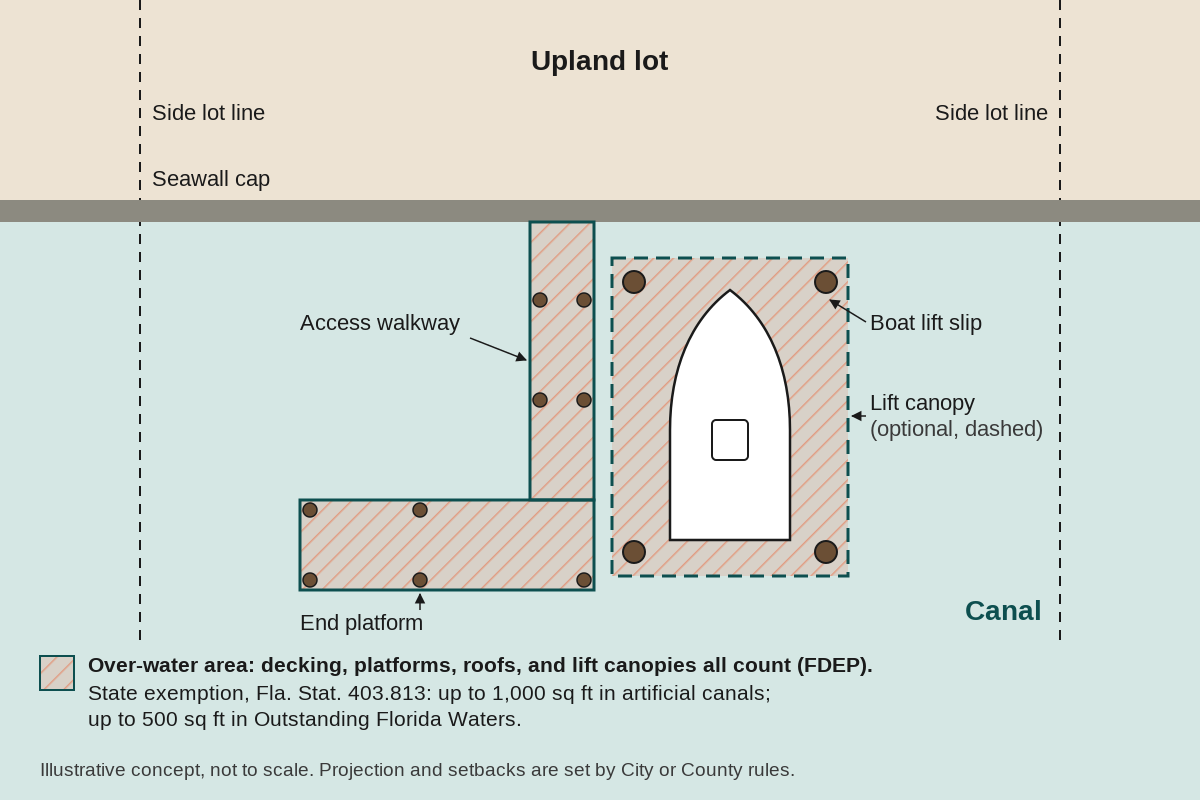
Parts of a canal dock, seen from above
You see a typical canal dock from above: seawall cap, access walkway, end platform, and a slip with a boat lift.
A dock project on a Cape Coral canal can involve three structures: the seawall the dock fastens to, the dock itself, and a boat lift. Each has its own permit path inside the city. This page walks through them in the order most owners meet them, then covers materials, bids, and the questions worth asking before you sign.
New docks
Inside city limits, new wood docks and new concrete docks go through the City of Cape Coral's Marine Improvement application on its CSS portal. The City's guidelines, revised January 2026, list who may apply: a general, building, or residential contractor (CGC, CBC, or CRC), a contractor in one of the two marine specialty classes the City names, or the owner as an owner-builder. The City does not allow private providers for these permit types.
The application package includes:
- a site plan, a dock layout, and dock details
- boat lift engineering, if the project includes a lift
- DEP approval, if the lot is not on fresh water
- a Burrowing Owl and Gopher Tortoise affidavit
Depending on the job, the City can also ask for a Notice of Commencement, an Eagle Management Affidavit, or a Hold Harmless Agreement for a used boat lift. An owner-builder adds an Owner/Builder Affidavit. Zoning reviews each application, with stormpipe and environmental review where they apply, and the permit closes with a Marine Final inspection.
Settling the layout
A canal dock layout can include a walkway or platform along the seawall cap, a wider platform at one end, and a lift slip beside it. Two sets of rules limit the footprint.
- State over-water area. Fla. Stat. 403.813 exempts a private dock of up to 1,000 square feet in an artificial canal. FDEP counts decking, elevated platforms, roofs, and boat-cover canopies toward that number.
- Local placement. The City's Land Development Code governs how far a dock can project into the canal and how close it can sit to the side lot lines. This site does not publish those numbers, because they need a reading of the current code. Ask City permitting staff or your contractor for the figures that apply to your lot before you settle on a size.
Boat lifts
A lift added during dock construction goes in the same application, with the lift's engineering attached. A lift added later can use the City's residential Boat Lift Only permit. That guideline, last revised in June 2020, accepts the same contractor classes plus owner-builders and asks for DEP approval if the lot is not on fresh water.
Either way, the lift motor's wiring needs a separate electrical permit, and the City's "Electric for Dock" guideline covers it. Plan on an electrical contractor as well as the dock builder.
Size the lift to the boat's weight with fuel, batteries, and gear aboard, and leave margin for the next boat. Matlacha Pass and other aquatic preserves carry one more rule. Under Fla. Stat. 258.42, a slip at a single-family dock holding a boat lift or davit that doesn't float when loaded may not be enclosed by walls, and a roof over it may not overhang more than 1 foot beyond the lift and the boat.
Seawalls
The City's residential seawall guideline was last revised in June 2020, so confirm current requirements with the City before relying on it. That version accepts applications from CGC, CBC, CRC, and marine contractors and from owner-builders. Plans can follow the City's approved Engineering Design Standards or carry the seal of an engineer or architect. Except on fresh water, the guideline asks for DEP approval or a federal general permit it names, and a floating turbidity screen has to enclose the work area during clearing, excavating, jetting, and backfilling.
On freshwater canals, the City's Waterfront Living Guide says seawalls are not required. The same guide covers mangroves along a seawall: owners can keep them trimmed to 6 feet without a permit, trimming mangroves taller than 10 feet takes a permit, and removing them is not allowed without one.
A dock rides on the seawall it meets. If the wall is cracked, leaning, or losing fill behind the cap, have it assessed before a new dock goes in. Replacing a wall after the dock is built means working around the dock.
Repairs
The City's repair guideline, revised January 2026, says re-decking without replacing the frame or stringers does not need a permit. Replacing framing, stringers, or pilings, or adding area, goes through the Marine Improvement application. Florida also exempts a replacement dock from a state permit if it sits within 5 feet of the old location, is no larger, uses no fill, and adds no permanent impact. The storm repair guide covers both rules in detail.
Materials for salt and fresh water
| Part | Choice | Tradeoff |
|---|---|---|
| Pilings | Treated wood | Ask which treatment use category the pilings carry, and get the answer in writing |
| Pile wraps | Plastic sleeves | Ask whether the plan includes them |
| Framing hardware | Galvanized or stainless steel | Ask which the plan specifies, and what grade |
| Decking | Treated wood or composite | Ask the contractor to compare upkeep for the boards they propose |
| Whole dock | Concrete | The City publishes a separate guideline for new concrete docks |
On a freshwater canal the wood stays out of salt, but the pilings still sit in water full time. Ask for the same piling treatment information either way.
Comparing bids
Ask for itemized bids that separate the seawall, the dock, the lift, electrical work, and permit fees.
Questions to ask before you sign
- What is your license number, and is it a state certified license or a local one? Check it at MyFloridaLicense.com.
- Can you show proof of insurance, including workers' comp or an exemption?
- Who prepares the drawings, and will a Florida engineer seal them?
- Which approvals does this lot need: the City or Lee County, DEP, and any federal authorization?
- What treatment category are the pilings, and what grade are the bolts and brackets?
- Who pulls the electrical permit for the lift?
- Will you record a Notice of Commencement? Under Fla. Stat. 713.135(1)(e), the permit office must receive a copy of the recorded Notice of Commencement before the first inspection when the direct contract is over $5,000. Florida's lien law (713.13, 713.02(5)) applies the notice requirement to improvements over $2,500.
- What warranty, if any, comes with the work, and is it in writing?
The contractor checklist guide explains how to read the answers. For permits by community, see the areas covered page, and for the difference between fresh and salt water lots, see canal types.
Plan your dock
Every dock project starts with the lot: which canal it's on, whether the water is fresh or salt, and which office issues the permit.
(239) 360-6861 Send a requestTide ranges
- Cape Coral Bridge
- 1.14 ft
- NOAA station 8725451
- Fort Myers
- 1.32 ft
- NOAA station 8725520
- Matlacha Pass
- 1.82 ft
- NOAA station 8725506
- St. James City
- 2.40 ft
- NOAA station 8725393
Great diurnal range in feet, from mean lower low water to mean higher high water, on NOAA's 1983 to 2001 datum epoch. Source: NOAA CO-OPS tidal datums (opens in a new tab), retrieved .
Common questions
Do I need a permit to build a dock in Cape Coral?
Yes. The City of Cape Coral, not Lee County, issues dock permits inside city limits. New wood docks, new concrete docks, and dock repairs, replacements, or additions all go through the City's Marine Improvement application on its CSS portal (guidelines revised January 2026). The City accepts applications from general, building, and residential contractors (CGC, CBC, CRC), from the marine specialty classes it lists, and from owner-builders. Private providers can't be used for these permits. If the lot is not on fresh water, the City also asks for DEP approval. A boat lift needs a separate electrical permit for its wiring.
Does replacing dock boards need a permit?
The City of Cape Coral's repair guideline (January 2026) says re-decking without replacing the frame or stringers does not need a permit. Replacing framing or pilings, or adding area, goes through the Marine Improvement application. At the state level, Fla. Stat. 403.813(1)(d) exempts repair or replacement of a dock within 5 feet of the same location, no larger than before, with no fill and no added permanent impact.
How big can a dock be without a state permit?
Under Fla. Stat. 403.813, a private dock of up to 1,000 square feet of over-water surface is exempt in artificial canals and outside Outstanding Florida Waters. In Outstanding Florida Waters, such as Matlacha Pass Aquatic Preserve, the limit is 500 square feet. FDEP counts roofs, boat lift canopies, and elevated platforms as well as decking toward that area. The state exemption doesn't replace local rules: the City or County sets how far a dock can extend into the waterway and how close it can sit to the side lot lines, so check those with the permitting office.
What's the difference between a freshwater and a saltwater canal for a dock?
On a freshwater canal in Cape Coral, the City's dock guidelines don't require DEP approval, and the City's Waterfront Living Guide says seawalls are not required. Freshwater canals hold stormwater and release it gradually to the tidal canals. On a saltwater canal, the City asks for DEP approval, and the wood and hardware sit in salt water. Gulf access, bridge clearance for sailboats, and depth along the route vary lot by lot, so check the route from your own dock rather than relying on a neighborhood's reputation.
How much does the tide move on Cape Coral canals?
Less than many people expect. At NOAA's Cape Coral Bridge station (8725451), the mean tide range is 0.82 feet and the great diurnal range is 1.14 feet. Ranges grow toward the Gulf: the Matlacha Pass station reads 1.82 feet and St. James City on Pine Island 2.40 feet (great diurnal range, 1983 to 2001 datum epoch).
Who permits docks on Pine Island, Matlacha, Bokeelia, and St. James City?
Lee County. These communities are unincorporated, so a dock, lift, or seawall needs a Lee County Dock and Shoreline permit, which contractors file through eConnect. The contractor needs a state license registered with Lee County or a Lee County certificate of competency. Parcels with more than two boat slips must meet the county's Manatee Protection Plan siting criteria, and docks longer than 200 feet need a benthic survey. As an Outstanding Florida Water, Matlacha Pass Aquatic Preserve has a 500-square-foot exemption limit, and because it is an aquatic preserve, FDEP's online self-certification is not available.
How do I check a dock contractor's license in Florida?
Search the contractor's name or license number at MyFloridaLicense.com, and for a company, check the individual qualifier too. Florida repealed its state Marine Specialty Contractor rule (61G4-15.033) in May 2024. The City of Cape Coral lists marine specialty classes among the applicants it accepts, and Lee County requires a state license registered with the county or a county certificate of competency. Ask any contractor for proof of insurance, and get the scope of work in writing.
Can I build my own dock as an owner-builder?
The City of Cape Coral accepts owner-builder dock applications with an Owner/Builder Affidavit. Under Fla. Stat. 489.103(7), the owner must personally supervise the work, appear in person to sign the permit application, and sign a disclosure statement. If the property is sold or leased within one year of completion, the law presumes the work was done for sale or lease.
Which building code applies to a dock permit?
The Florida Building Code 8th Edition (2023) is in force now. The 9th Edition takes effect on December 31, 2026, according to the Florida Building Commission. If a permit application will land near that date, ask the contractor which edition the plans are drawn to.
What happens when I send a request through this site?
Your request goes to an independent local contractor who works on docks, lifts, or seawalls in the area. That contractor may call or text you about the project and may pay for the referral. Cape Coral Docks does not perform construction work and does not set prices.
Planning a dock, lift, or seawall?
Describe your waterfront and the project. Your request goes to an independent local contractor, who may call or text you about it.
Areas covered: Cape Coral, FL, Fort Myers, FL, Pine Island, FL, Matlacha, FL, Bokeelia, FL, St. James City, FL.